
Working with funders and partners
To provide more small, rural communities in California with safe water, we're working on two fronts. First, securing public and philanthropic funds. Second, partnering with the organizations already supporting communities whose water is impaired.
The technology is proven. What is needed now is the capital and communities to scale.
Funders
Public and philanthropic funds
We are securing capital to build treatment systems without the cost of borrowing; operating support while the Virtual Water District grows to a sustainable number of communities; and a fund that keeps treatment affordable for households.
Partners
Technical assistance orgs & regulators
We are partnering with the organizations that provide technical assistance to small communities, and with the public agencies responsible for compliance, to meet the communities where our treatment + management solution fits best.
We have the political will. And now - a new tool.
California has a program aimed at exactly these communities. SAFER — Safe and Affordable Funding for Equity and Resilience — is how the State Water Board finds failing water systems and pays to fix them.
SAFER has already awarded more than $900 million in grants, and commits $130 million a year through 2030 from the state's Safe and Affordable Drinking Water Fund.
SAFER's first preference is consolidation: running pipe to join a small system to a larger utility. That is the right answer where there is a nearby community with a safe drinking water source. But the high costs of building have forced the state to set viability thresholds that can rule it out.
Where a main is too far, or the total project costs are too high, consolidation won't work for small, rural communities. And even when it's viable, the process can take several years.
Figures from the California State Water Resources Control Board: 2025 Drinking Water Needs Assessment, FY 2025–26 Fund Expenditure Plan, and the 2024 physical consolidation cost methodology.
How this fits the state's approach and community priorities
The state looks for
Long-term solutions. Where connecting to a larger water system is not practical, treatment of the source water for a community provides more protection than sink filters.
WellForward
Treats all the water for every home on the well, for the long term.
The state looks for
A way for small communities with limited funds and technical staff to share the costs of professionally managed water treatment.
WellForward
Provides a way to operate multiple small systems under managerial consolidation, instead of physical consolidation.
Community priorities
Concerns about losing control of costs through consolidation, and having to wait many years for the planning and land rights to lay pipes.
WellForward
Provides a faster path to safe water, and a straight-forward service agreement.
Our process
We will establish the Virtual Water District by bringing our technology and management to more communities, in five steps.
Once a community is interested, we oversee design, siting, permitting, construction and commissioning, then maintain the systems through regular visits by our licensed operator, with remote oversight.
-
Identify, engage, and evaluate communities
- Identify communities through partner organizations and agencies already supporting them
- Engage, demonstrate the technology and establish trust
- Measure water consumption and water quality
- Design the site layout and the upgrades needed to existing infrastructure
- Agree on final terms and service costs
-
Secure funding
Arrange for public infrastructure funds, and for operating subsidies where a disadvantaged community needs them.
-
Final design and permitting
Submit the final construction plans, along with the treatment system's design and operating plan, to local agencies for permitting.
-
Manufacturing
Arrange system manufacturing contract for system completion in one to three months.
-
Construction and commissioning
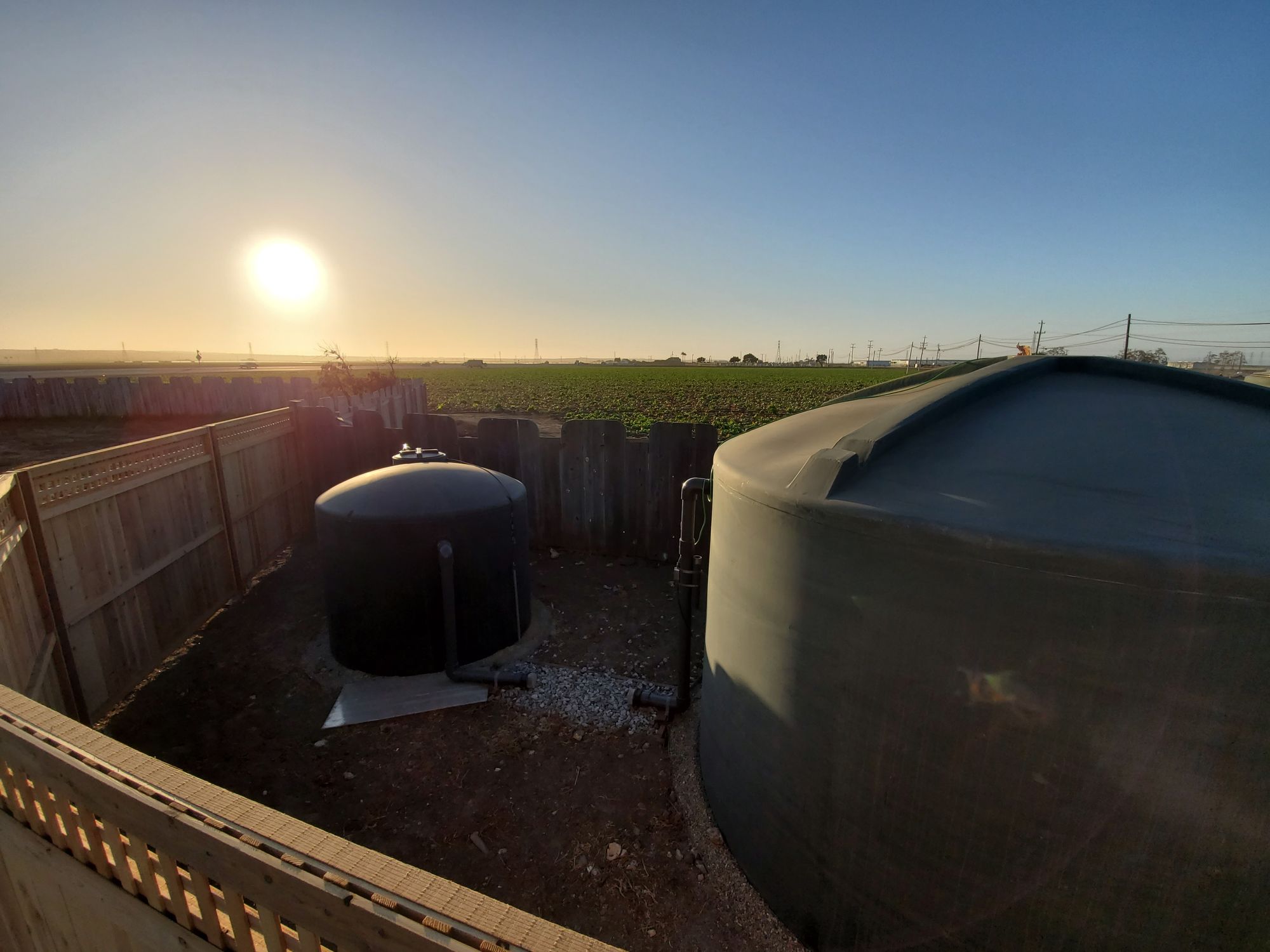
Site updates, water lines, storage tanks, and a small shed for the treatment unit, followed by system deployment and regulatory approval - about one to three months.
The wells and communities this is for
We're looking for wells impaired by contaminants that serve multiple households, and where consolidation is unlikely, or years away. We're establishing our first Virtual Water District in Monterey County, and exploring other geographies.
- Size
-
- Mainly wells that serve about 5 to 30 households
- Also works for fewer connections
- We plan to develop a solution for communities with multiple wells and up to 300 households
- Who and where
-
- Year-round or seasonal residents, schools, or mobile home parks
- Communities too far from a larger, safe water system to easily connect, or where the consolidation process has stalled for many years
- Well and wastewater
-
- Well water that does not meet drinking water standards, particularly where there are multiple contaminants
- Wastewater discharged to one or more community septic tanks, or potentially to sewerage
What we're raising
Capital funding
To build new systems - without the cost of borrowing - so that costs stay affordable.
Establishing WellForward
Support for WellForward as a nonprofit, so we can manage the Virtual Water District while we grow to a sustainable number of communities.
Community assistance program
A fund to help cover the cost of treatment operations for households that can't afford it.
Work with us
Whether you're funding this work, or you work with a community that might be a fit, we'd like to hear from you.